Embedded Files
The Advantages of Non-Verbal Hypnosis: Different Hypnotic Pathways Prepare Different Responses
The importance of non-verbal hypnosis goes beyond inducing trance without words. Through gaze, posture, movement, breathing and sensory stimulation, it may engage automatic bodily mechanisms shared with more primitive forms of nervous-system regulation, and facilitate the unfreezing mechanism and better vagal regulation.
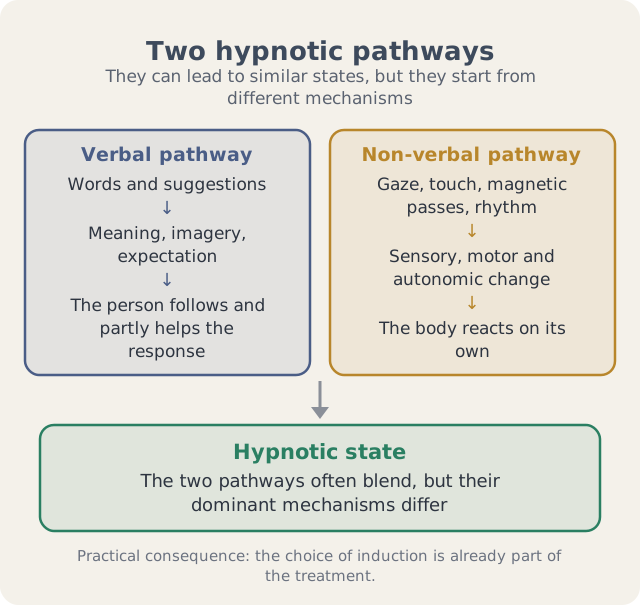
Different inductions can prepare different functional responses. A verbal induction may work primarily through meaning, imagery and expectation, while a non-verbal induction may begin by changing the body's sensory, motor and autonomic organisation. Both pathways can interact and sometimes lead to similar hypnotic states, but they need not develop exactly the same capacities.
This has an important therapeutic implication: the choice of induction can already be part of the treatment. Rather than asking only how deeply a person can enter hypnosis, we can ask which pathway may best prepare the nervous system for the specific change we want to facilitate.
Non-verbal hypnosis works through stimuli such as gaze, sound and touch. These stimuli activate the unconscious mind. Think of listening to music: you cannot help feeling certain emotions. Think of being touched: your attention immediately goes there.
Verbal hypnosis uses words that the conscious mind understands in order to activate unconscious reactions, while non-verbal stimuli reach the unconscious directly. This is why non-verbal hypnosis is the ideal tool for evoking bodily responses, and it can bring about powerful healing by operating directly on the unconscious.
Our deepest self is non-verbal. When we were born, we did not know how to speak. The non-verbal touches the deepest mental circuits of a person. The ancient hypnotists worked non-verbally, and they described hypnotic reactions that many people rarely see today.
Imagine an ancient non-verbal hypnotherapist or magnetist working almost silently. A steady gaze or a few hand passes are followed by a rigid arm or a sudden change in the feeling of pain. Now imagine a modern verbal hypnotist asking someone to keep an arm raised. The two demonstrations can look similar, but the reactions need not be the same.
One person is following a suggestion and partly helping the movement. Another person experiences the arm becoming rigid on its own, without choosing to hold it there. This second reaction points to an automatic change in how the nervous system works. These are two kinds of hypnotic reaction, not two explanations of one reaction.
1. Following a verbal suggestion
A suggestion implies understanding words. The person hears a suggestion, understands it, imagines the result and partly helps it happen. Attention plays a large part. This is a genuine hypnotic reaction.
2. The non-verbal way: the body reacts on its own
This is a physiological reaction. The body responds on its own, without the person deciding to make it happen. Movement, muscle tone, sensation or breathing may change automatically. We study this as a different way in which the nervous system works.
The old magnetists frequently described involuntary reactions, while modern verbal methods often give more attention to following suggestions. Both forms belong to hypnosis. The useful question is: what is actually happening in the body this time?
The two forms often happen together, but their dominant mechanisms differ. The following sections connect catalepsy, animal hypnosis, somnambulism and polyvagal regulation. This is the practical meaning of our research into animal hypnosis applied to humans: familiar hypnotic phenomena reveal bodily responses that words alone may not explain.
Why non-verbal hypnosis? In our practice we observe that non-verbal stimulation (gaze, posture, touch, the rhythm of breathing) leads people into a deeper state than verbal stimulation alone. The non-verbal carries more information than words: words are only a map of the experience. Animal hypnosis, too, is entirely non-verbal. Experienced hypnotists already know this language of the body: a fixed gaze, an arm held in catalepsy or an instant shift of state before a long verbal induction has even begun. The same familiar reactions become more interesting when we look closely at their different functions. For example, an experienced hypnotist can suggest that a person's hand is becoming lighter. Without a deliberate effort to lift it, the hand starts to rise. This familiar hand-levitation response offers a simple doorway into a deeper question: how can an image or a few words set movement in motion? One neurofunctional interpretation is that suggestion recruits motor patterns the body already knows. During hypnosis we observe the movement itself, the person's sense that it is happening almost by itself, and whether breathing and contact remain easy.
Animal Hypnosis and Catalepsy
Animal Hypnosis and Catalepsy
This video shows an animal that has become catatonic (a state of animal hypnosis) out of fear of passing cars.

Animal Hypnosis and the Four States
Animal Hypnosis and the Four States
When we study animal hypnosis in the light of polyvagal theory, we find behaviours and nervous-system states shared across species. Four states stand out: catalepsy, somnambulism, lethargy and fascination. Each one corresponds to a specific way in which consciousness and the body respond. Stillness itself does not always mean fear. A cat may become motionless while observing its surroundings or preparing to leap, whereas an animal facing danger may freeze defensively. Similar outward postures can serve different functions. This is why the comparison also includes attention and readiness for action, not only defensive immobility. Take the classic arm-catalepsy test: the hypnotist gently raises an arm, then removes the support, and the arm remains in place. In hypnosis the subject may be calm, attentive and able to communicate; in animal tonic immobility the outward stillness may instead be protective. A polyvagal reading begins with this distinction. We ask what the stillness is doing for the person, whether defensive mobilisation is present, and how the person returns to free movement. Catalepsy is therefore more than a spectacular hypnotic trick: it becomes a window onto the organisation of the body's responses.
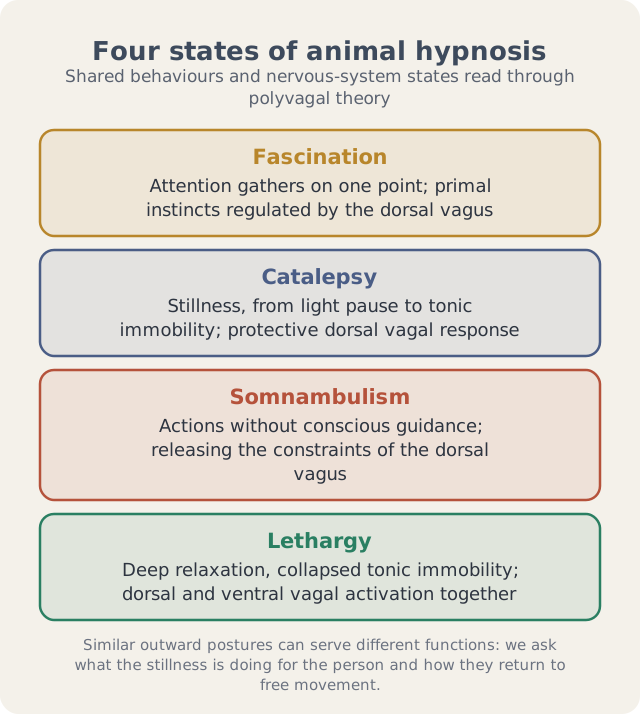
Fascination is more than an intense gaze: it opens the way to deep focus. For a moment the flow of thoughts quiets down and attention gathers on a single point. It reaches the oldest areas of the brain and activates primal instincts regulated by the dorsal vagus (the branch of the vagus nerve that slows the body down and, under threat, can lead to immobility).
Catalepsy is a state of stillness, from a light pause to full tonic immobility (the body stays rigid and motionless, as in an animal that 'plays dead'). This protective response, found both in the wild and in humans, shields the person from overwhelming stress, an effect of the calming action of the dorsal vagus. Hypnotic arm catalepsy makes the comparison visible. The person's arm stays suspended, sometimes with an expression of profound stillness. Yet this does not automatically mean the person is experiencing the same defensive state as an animal in danger. A polyvagal interpretation asks about the accompanying breathing, attention, contact and readiness to move. The experiment is useful precisely because it teaches the hypnotist to distinguish a posture from the function of the state behind it.
Somnambulism, in which actions unfold without conscious guidance, mirrors the process of releasing held emotions and memories. Here polyvagal theory helps us understand how past traumas can be resolved: healing comes through releasing the constraints of the dorsal vagus. In traditional hypnosis, somnambulism can also be active: a person may enter an imagined scene, speak, move and respond to suggestions as though the experience were unfolding around them. This offers a useful comparison with expressive movements during mesmeric crises. The phenomena are not identical, but both invite us to observe how trance organises action. Imagine a subject in deep hypnotic somnambulism who walks into an imagined scene, speaks to someone who is not physically present, then changes posture as an emotion rises. The image is organising a real bodily response. This is close to what we call a crisis directed through an image: rather than movement emerging only from direct bodily stimulation, a hypnotic scene recruits emotion and action. Functionally we can describe mobilisation alongside sufficient connection with the hypnotist to continue safely. Classic hypnosis, including the work of Milton Erickson with somnambulistic trance, gives the experienced hypnotist a useful point of comparison with mesmeric release.
Lethargy brings deep relaxation and can evolve into collapsed tonic immobility (the body becomes limp and heavy), a space for introspection and renewal. This state may combine dorsal and ventral vagal activation (the ventral vagus is the branch linked to safety and social connection), and it marks a return to one's core. An experienced hypnotist knows that deep relaxation and immobility caused by fear are not the same experience, even if both look quiet from outside. Our observations invite us to consider CARE: the sense of safety and supportive contact that can accompany profound rest. In our functional reading of the polyvagal model, several regulatory patterns may work together.
We observed these hypnotic states in our practice well before the polyvagal perspective was available to explain them. Today this perspective offers a useful way to understand how our nervous system produces them. It also shows parallels between human and animal experience, based on biological and emotional mechanisms common to both, and this supports our work of understanding and healing. For more than twenty years, Dr. Paret and his School have studied these transitions through direct observations in hypnosis and Animal Magnetism. We look at the gaze, breathing, muscular tone, spontaneous movement and the quality of contact. We call this a neurofunctional perspective: first we observe what the response does, then we explore which neurological mechanisms might explain it.
Cataleptic States in Humans
Cataleptic States in Humans
In work with the polyvagal mesmeric crisis (the spontaneous release reaction of the body), reaching the state of catalepsy is an important step towards resolving the problem. We also watch what happens after the stillness: a change in breathing, a spontaneous tremor or the return of movement. Each change gives the practitioner a clue about how the person's state is evolving. A strong emotional reaction can be especially meaningful. During hypnosis a person may begin to tremble, cry, breathe more deeply or make a movement that had previously felt impossible. In the observations of Dr. Paret's School, we follow the whole sequence: a blocked or frozen response, the return of mobilisation, completion of the response, and renewed calm and contact. Seen through the polyvagal lens, the therapeutic point is not the intensity of the emotion but the resolution of the defensive block. When that process reaches completion in a successful case, the trauma-related block is resolved and the person can respond in a new way.
Learn the method
Mesmeric Polyvagal Therapy is taught in the courses of Dr. Paret's School (ISI-CNV – Université Européenne): live seminars and online lessons, from the first-level Master to advanced training, with specific expertise in polyvagal hypnosis, trembling, completion of the response and ventral vagal stimulation. Request the programme and the next dates: our first contact is always a WhatsApp message, never a call.
→ Request information on the courses
→ Dr. Paret's videos and international activity
→ marcoparet.com: the School of Dr. Paret
This site is available in: English · Italiano · Français · Русский · 中文
Research notes
A selection of peer-reviewed studies on polyvagal theory and vagal function that offer a scientific reading of the topics discussed in this article.
Aubert AE, Verheyden B, et al. (2009). Cardiac autonomic regulation under hypnosis assessed by heart rate variability: spectral analysis and fractal complexity. Neuropsychobiology, 60(2), 104-112. In 12 healthy participants, hypnosis was associated with higher normalised high-frequency HRV and a lower LF/HF ratio, without a change in heart rate; the authors note that changes in breathing depth may partly explain the result. https://doi.org/10.1159/000239686
Padilla VJ, Scheffrahn K, et al. (2024). Heart rate variability, hypnosis, and psychotherapy. Applied Psychophysiology and Biofeedback, 50(2), 289-295. This review summarises how HRV changes during hypnosis and proposes mechanisms through which hypnotherapy may influence the stress response, while calling for randomised controlled trials to confirm these links. https://doi.org/10.1007/s10484-024-09679-6
Carli G, Farabollini F (2022). Tonic immobility as a survival, adaptive response and as a recovery mechanism. Progress in Brain Research, 271(1), 305-329. Reviewing animal research on tonic immobility (classically called 'animal hypnosis'), the authors argue that it is an adaptive survival response, modulated by environmental risk, and that it may also activate recovery mechanisms after disruptive experiences. https://doi.org/10.1016/bs.pbr.2022.02.012
Woodruff ML (2025). Tonic immobility and phenomenal consciousness in animals: a review. Frontiers in Psychology, 16, 1509999. A recent review distinguishing tonic immobility from broader death-feigning behaviour and discussing what forms of awareness may accompany it; it is a cautious reference for the old link between animal immobility and hypnotic phenomena. https://doi.org/10.3389/fpsyg.2025.1509999